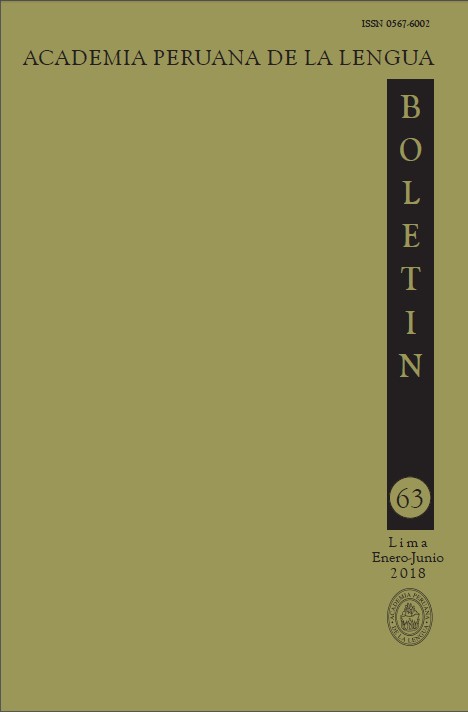
The metaphors of personification in «Qalachuyma, traditional aymara songs»
-
Alan Ever Mamani Mamani
Universidad Nacional del Altiplano
.gif) https://orcid.org/0000-0002-4690-0130
https://orcid.org/0000-0002-4690-0130
Abstract
This paper is confined to the current of cognitive linguistics, which aims to categorize and analyze the metaphors of personification in traditional Aymara songs. The data have been collected in the songbook “Qala chuyma, traditional Aymara songs”. In analyzing the metaphors, three types of categorizations have been found: animals as animate beings,
objects as animate beings, and customs as animate beings. It is concluded that the different metaphors expressed in the Andean elements show and acquire human qualities and attitudes. They coexist with the Aymara man in his daily work. Therefore, they are considered in the Andean world as animate beings.
Downloads
Copyright (c) 2018 Alan Ever Mamani Mamani

This work is licensed under a Creative Commons Attribution 4.0 International License.
Authors retain their rights:
a. The authors retain their trademark and patent rights, as well as any process or procedure described in the article.
b.The authors retain the right to share, copy, distribute, perform and communicate publicly the article published in the Boletín de la Academia Peruana de la Lengua (for example, placing it in an institutional repository or publishing it in a book), with an acknowledgment of its initial publication in the Boletín de la Academia Peruana de la Lengua.
c. Authors retain the right to make a subsequent publication of their work, to use the article or any part of it (for example: a compilation of their work, notes for conferences, thesis, or for a book), as long as they indicate the source of publication (authors of the work, journal, volume, number and date).