Uncertainty of what is factual in the discourse: Semantic and pragmatic use in the sequence containing "Como + Que" (as though) in Spanish
Abstract
In Spanish the sequence como + si (as if ) permits us to define potential or possible events that do not have a real existence. This means that they are not part of the world of facts, and lack a true existence. An expression like “Fue como si me explotara la cara de vergüenza cuando lo vi” (“It was as if my face was about to explode with shame when I saw him”) permits us to compare a real experience with another that is purely idealized. Discoursively, expressions like these only seek to give us a framework in which the fact is exaggerated in the speech, or they intentionally present a conjectural framework that tends to define the probability of a fact not evidenced by the speaker. Now, a similar discursive function is detected in the alternative variable “como + que” (as though); nevertheless, certain expressions which make up the corpus from which the pertinent analysis will be derived, are referred to objectively corroborating facts, which are assumed as conjectures, not as experiences or verifiable data. The discursive effects, therefore, correspond to a relativization of the factual, of the real events, in the speech. Our goal in this article is to describe the phenomenon of relativization of the factiticity as a pragmatic effect
making a syntactic tracking to then define the pragmatic effects of the sequence “como + que” in real situations of speech.
Downloads
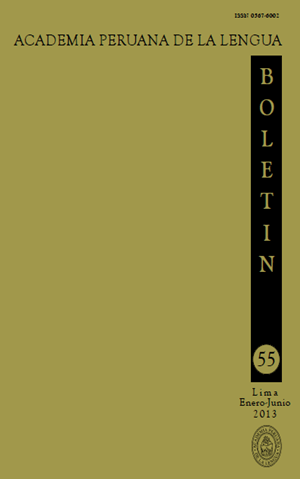
Copyright (c) 2013 Rolando Rocha Martínez, Manuel Conde Marcos

This work is licensed under a Creative Commons Attribution 4.0 International License.
Authors retain their rights:
a. The authors retain their trademark and patent rights, as well as any process or procedure described in the article.
b.The authors retain the right to share, copy, distribute, perform and communicate publicly the article published in the Boletín de la Academia Peruana de la Lengua (for example, placing it in an institutional repository or publishing it in a book), with an acknowledgment of its initial publication in the Boletín de la Academia Peruana de la Lengua.
c. Authors retain the right to make a subsequent publication of their work, to use the article or any part of it (for example: a compilation of their work, notes for conferences, thesis, or for a book), as long as they indicate the source of publication (authors of the work, journal, volume, number and date).